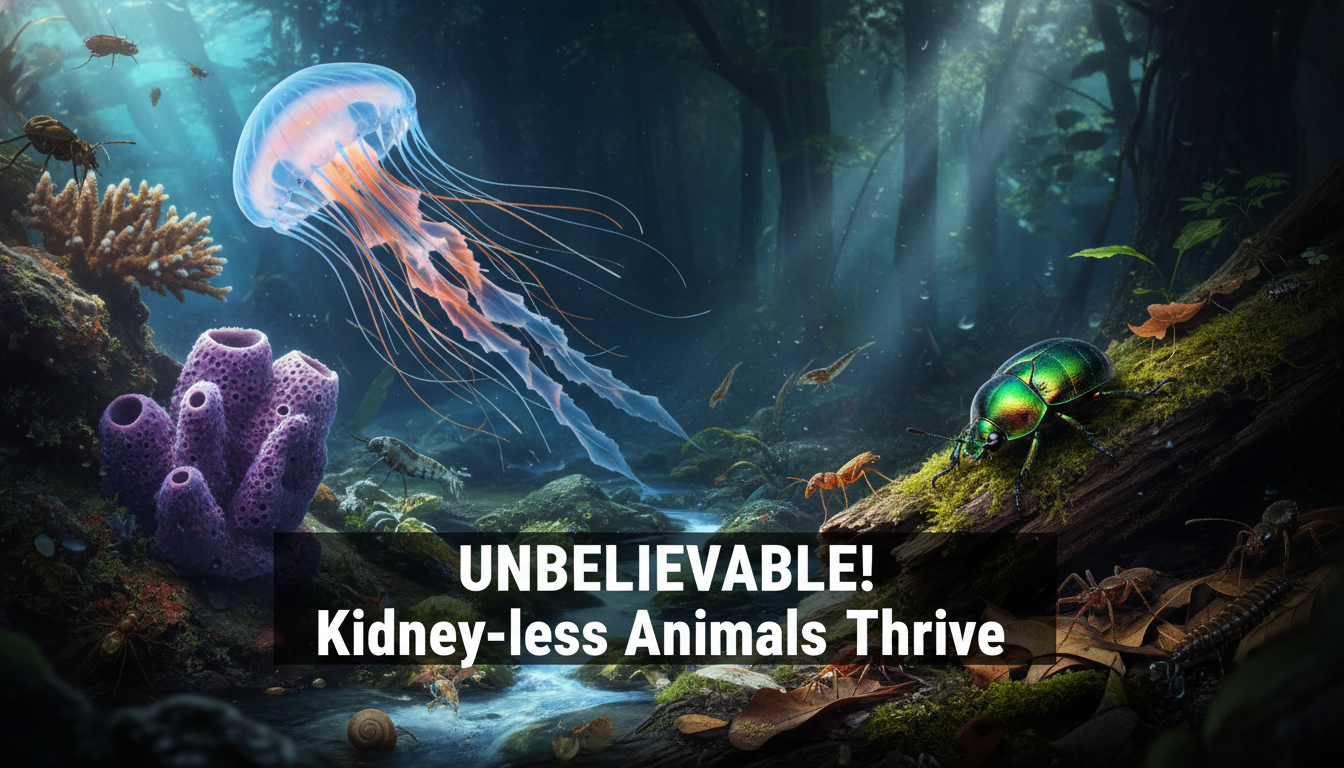
Kidney-less Animals are more common than you might think. Imagine a world where life thrives without these vital organs. Indeed, many creatures manage waste and maintain balance in astounding ways. This exploration will uncover some of nature’s most ingenious adaptations. It truly challenges our traditional understanding of animal biology. Consequently, we often overlook these amazing organisms.
The Kidney’s Critical Role
In most vertebrates, kidneys are essential for survival. They filter blood, remove waste products, and regulate water balance. Furthermore, kidneys maintain electrolyte balance and blood pressure. Without them, toxins would quickly accumulate. This would lead to severe health issues. Therefore, the absence of kidneys in some animals highlights remarkable evolutionary paths.
Meet the Kidney-less Wonders
Many invertebrates have evolved alternative systems for waste removal. For instance, sponges, cnidarians (like jellyfish and sea anemones), and echinoderms (such as starfish) notably lack kidneys. These aquatic creatures use simple diffusion to excrete nitrogenous waste, primarily ammonia. Their body fluids are often similar to seawater. Hence, they regulate at the cellular level. This simple yet effective method suits their environment perfectly.

Simple Solutions for Simple Lives
Consider the humble sponge. It filters water through its porous body. Waste simply diffuses out into the surrounding water. Similarly, jellyfish have a basic body plan. They also rely on diffusion for excretion. This lack of complex organs underscores their ancient lineage. In fact, many primitive marine animals share this characteristic. They have perfected survival through simplicity.
Insects: Masters of Adaptation
Insects, a vast group, do not possess kidneys. Instead, they use specialized structures called Malpighian tubules. These tubules efficiently remove metabolic wastes from the hemolymph (insect blood). They then deposit these wastes into the hindgut. From there, uric acid is expelled as dry material. This adaptation is crucial for their terrestrial lifestyle. Consequently, insects can conserve water very effectively. Spiders also employ Malpighian tubules for similar purposes. Therefore, these tiny creatures demonstrate incredible physiological ingenuity. Animal Swarms often include many of these fascinating insects.
Life Without Kidneys: A Different Kind of Design
The variety of excretory organs in invertebrates is truly diverse. Beyond Malpighian tubules, some have nephridia or renal glands. These structures perform kidney-like functions. For example, annelids (like earthworms) use nephridia. These fine tubules filter coelomic fluid and excrete waste. This highlights how life finds many paths to solve common biological problems. The body plans of these animals are uniquely suited to their needs. The Midnight Code explores more unusual animal behaviors and adaptations.

Marine Marvels
Echinoderms, like sea urchins, exhibit radial symmetry. They lack dedicated excretory organs entirely. Nitrogenous waste is simply released directly into the water. Cnidarians, such as corals and sea anemones, similarly rely on their aquatic environment. Water constantly flows through their bodies. This facilitates easy waste removal. Thus, the ocean provides a natural medium for these Kidney-less Animals to thrive.
Terrestrial Innovators
Even on land, some arthropods have unique systems. Beyond insects and spiders, certain terrestrial crustaceans and other arthropods utilize adapted excretory systems. These often involve modifications to their circulatory and digestive systems. The ability to excrete dry waste, like uric acid, is a major advantage. This prevents water loss, a critical concern for land-dwelling creatures. Hence, evolution has crafted diverse solutions for maintaining internal balance.
Understanding Nature’s Ingenuity
The existence of Kidney-less Animals reminds us of life’s vast diversity. It demonstrates that complex organs are not always necessary. Simple, efficient systems can be equally effective. From the sponges of the deep to the insects buzzing around us, these creatures inspire awe. Their adaptations offer valuable insights into evolution. This truly underscores the endless possibilities in the natural world. Therefore, next time you see an insect, remember its unique physiology.